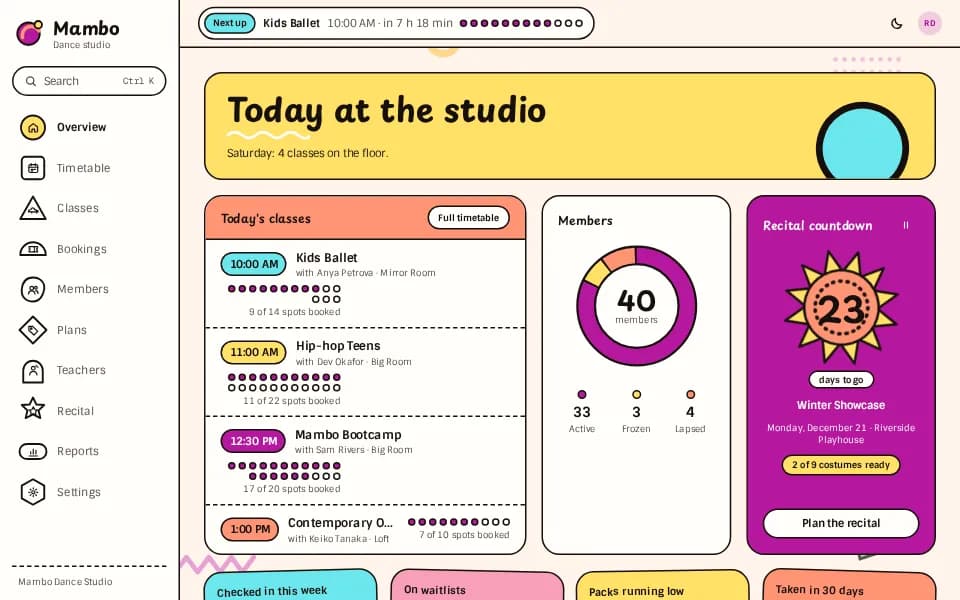
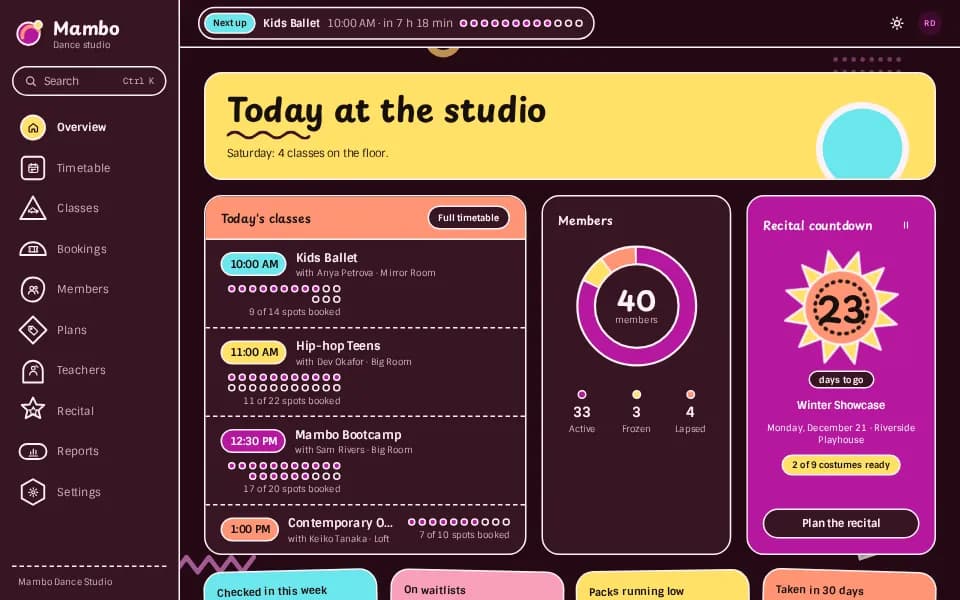
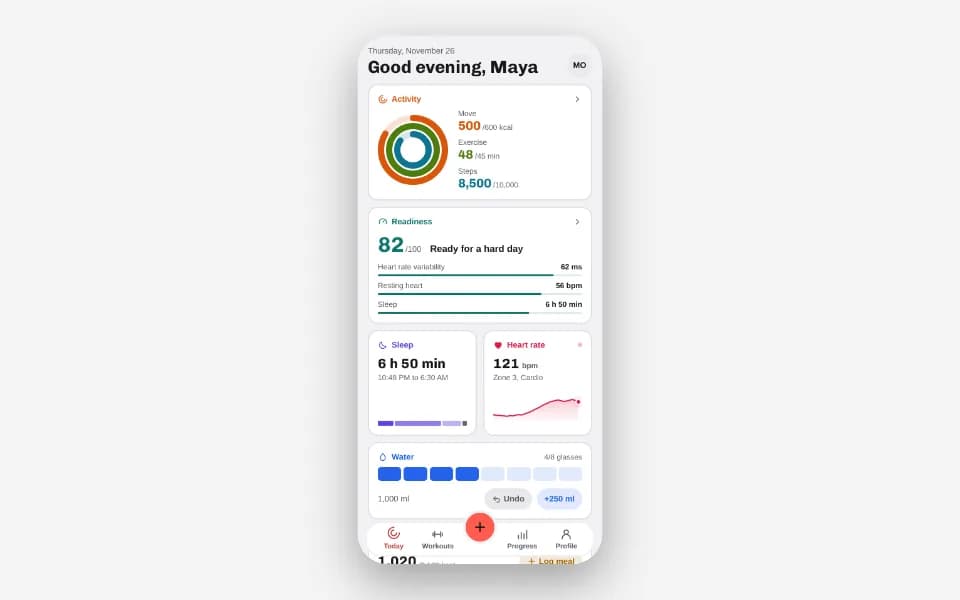
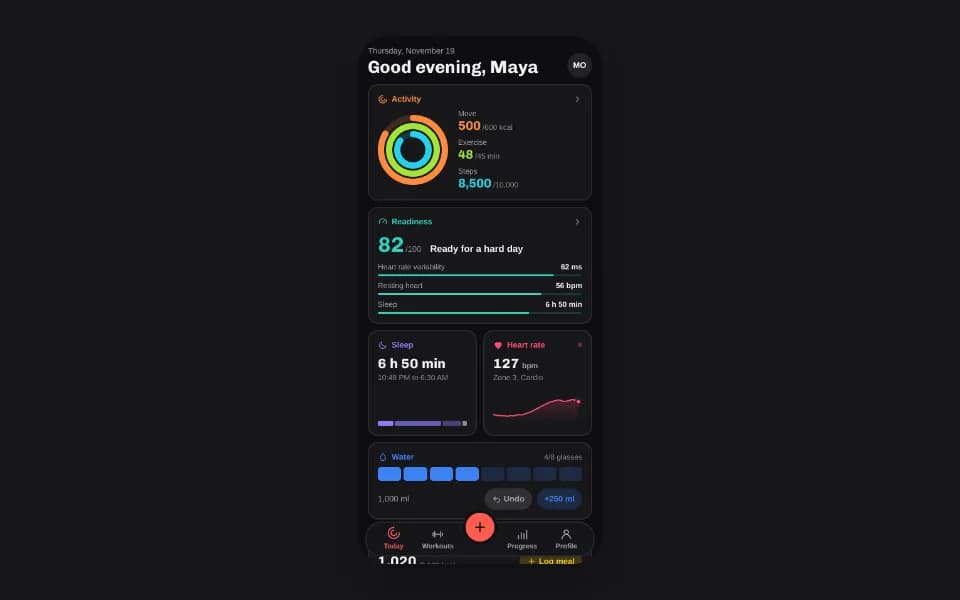
A soft neumorphic desk for a small hearing clinic: patients, a day board by audiologist, audiograms per ear and a band-by-band fitting equaliser.
Web
10 صفحات
$69
صفحے کا پتہ: /
نیچے مزید ↓
پہلے سے شامل
آپ کو کیا ملتا ہے
لائٹ اور ڈارکآپ کی تھیم کے رنگ استعمال کرتا ہے
ڈیسک ٹاپ، ٹیبلٹ، اور فونوہ اسکرینز جن کے لیے یہ بنایا گیا
پیکجز…
کوڈ کا سائز…
بیٹری پر ہلکا30 fps، ساکن ہو تو رک جاتا ہے
چھپنے پر رک جاتا ہےاسکرین سے باہر یا دوسرا ٹیب
کم حرکتجو لوگ کہیں ان کے لیے پرسکون
ہر تبدیلی پر جانچ
سکیورٹی جانچ 28 نومبر
ٹائپ چیکTypeScript strict
لنٹ اور فارمیٹESLint · Prettier
ٹیسٹ اور بلڈلائٹ اور ڈارک اسکرین شاٹس
سکیورٹی آڈٹکوئی ہائی یا کریٹیکل ایڈوائزری نہیں
پیکج کی عمرہر ورژن 7+ دن سے عوامی
فارغ CPUآرام میں آدھے کور سے کم، ≤ 30 fps
کوڈ
اس ایپ میں کچھ گڑبڑ ہے؟ فیڈبیک بھیجیں ›
hearing-cochleaReact
hearing-cochlea.tsxpageThe page: the sections in order.
content.tscontentEvery word and number: brand, nav links, each section's copy and lists.
theme.tsthemeThe colors as CSS variables, and the shared class strings.
README.mdreadmeHow to install it, and where to change the text, colors and form.
pagespagesOne file per page: the sections it shows, in order.
appointments.tsxpageAppointments: the day board by audiologist (drag or keys to move a visit) or the week as a list with Mark done and Cancel, filtered by visit type, with the day in the address so Back keeps it.
audiograms.tsxpageAudiograms: every test newest first with each ear's average and the hearing grade, filtered by test type and grade in the address; record, edit or delete a test with the live threshold grid above the list.
devices.tsxpageDevices: hearing aid models with stock you can step up and down (low and out marked in words and color), add, edit and delete; and every fitting made, newest first.
home.tsxpageOverview: four stat keys that open their lists, today's list by audiologist beside the follow-ups due, then device stock, open repairs and tests per week.
patient.tsxpageOne patient: their name and actions on top, then tabs (in the address) for the profile with the follow-up date and latest audiogram, audiograms to compare, the fitting equaliser, history and notes.
patients.tsxpagePatients: everyone on file in a table, filtered by status (or follow-up due), by audiologist and by a name or phone search, all kept in the address so Back returns to the same list.
repairs.tsxpageRepairs: aids in for repair on a board by status; drag a card to the next column (or use its Move to menu), with Undo; open a card to edit or delete it.
reports.tsxpageReports: over the last 4 or 10 weeks (in the address), tests and fittings per week, the follow-up rate after fittings, visits kept, and each audiologist's numbers.
settings.tsxpageSettings: the clinic's name and opening hours, the audiologists, the palette (kept in this browser) and Appearance (style, theme and language).
sign-in.tsxpageThe sign-in page (#/sign-in): a soft panel with a drawn equaliser (eight raised caps on sunk tracks, still) and the cochlea spiral beside the form, without the sidebar and top bar.
sectionssectionsOne file per page section.
account-menu.tsxsectionThe account menu under the avatar in the top bar: who is signed in, Settings and Sign out; the arrow keys move through it, Escape, Tab or a click outside closes it.
appearance.tsxsectionSettings → Appearance: the style (Glass or Solid) and the theme (System, Dark or Light), each choice shown as a small preview, and the language (System or one of locales/list.ts).
appointment-dialog.tsxsectionBook or edit a visit: who it is for, with whom, what kind, the day, a time in 15-minute steps inside opening hours and how long; an edit also sets its status.
audiogram-form.tsxsectionRecord or edit a test: patient, date, type and audiologist, then a threshold per ear and frequency (5 dB steps), with the audiogram drawing live beside the grid.
day-board.tsxsectionThe day board: one column per audiologist, the day's hours down the side, each visit a raised card at its time; drag a card (or pick it up with Space and move it with the arrows) to another time or audiologist, with Undo.
fit-dialog.tsxsectionFit an aid: the model (with its stock), which ear, the day and the serial number; its programs start from the patient's latest audiogram.
model-form.tsxsectionAdd or edit a hearing aid model: brand, name, style, channels, stock, reorder level, price and warranty.
patient-audiograms.tsxsectionThe patient's Audiograms tab: one visit's tones on the chart, an earlier one dashed under it to compare, and each ear's average with how much it moved.
patient-fitting.tsxsectionThe patient's Fitting tab: the aid they wear, a program and ear pick, and the band-by-band equaliser against the prescription target, saved per program and ear; with fitting a new aid and removing one.
patient-form.tsxsectionAdd or edit a patient: name, year of birth, phone, email, their audiologist, status and the next follow-up date.
patient-notes.tsxsectionThe patient's History tab (visits, tests, fittings and repairs on one timeline, newest first) and Notes tab (write, edit and delete notes, with Undo on delete).
repair-form.tsxsectionLog or edit a repair: whose aid, which model, the problem, when it came in, where it is and when its warranty ends (worked out from the fitting when left empty).
sidebar.tsxsectionThe nav capsule: a raised pill floating mid-left with the logo, round page keys (labels as tooltips) and search; the current page's key sits pressed in with a lit accent LED. In the phone sheet the same keys show their labels.
sign-in-form.tsxsectionThe sign-in form: email and password with their errors under them, show or hide the password, keep me signed in, and the demo account to fill in; a wrong pair says so above the fields.
team.tsxsectionSettings' Audiologists card: the team with their rooms and patient counts; add, edit (in place) and remove one, whose patients and visits move to the first one left.
today.tsxsectionOverview's today list: one lane per audiologist with their visits in time order; what is on now carries a lit LED and the word Now, what is done sits quieter with a check.
top-bar.tsxsectionThe top bar: the menu key on narrow screens, the current page's name, today's date and opening hours, search on narrow screens, the theme switch and the account menu.
week-list.tsxsectionAppointments' week list: every visit of the shown week in time order, with Mark done (Undo) and Cancel (after a confirm), and an edit button per visit.
partspartsWhat several sections share.
buildbuildWhat several sections share.
cardscardsWhat several sections share.
rise.tspartThe rise card style: cards rise and fade in (24px, a hair smaller), one after another.
rowsrowsWhat several sections share.
unfold.tspartThe unfold row motion: each row on screen opens down from its top edge, from faint.
core.tsxpartThe page's build-in: on first load and on every page switch the cards arrive in the app's card style and their contents build: bars grow, lines draw, rings fill, the list rows on screen ripple in in the app's row motion, numbers count. The two picks are wired in ./index.ts.
index.tspartThe app's two build-in picks, wired here and nowhere else: its card style (cards/) and its row motion (rows/). npm run new-app copies only the two it is given (--cards, --rows).
appearance.tspartHow the app looks right now: dark or light, Glass or Solid, from Settings → Appearance, the page around it and the Style setting.
audiogram-chart.tsxpartThe audiogram: hearing level (dB HL, louder down) by frequency for each ear, the right ear as O and the left as X, an earlier visit dashed behind; the line traces and each point pops in by frequency.
avatar.tsxpartA person's initials in a round badge, tinted with the primary.
backdrop.tsxpartThe Glass style's backdrop: what shows through the see-through panels, faded out in Solid; with followBackground it paints your background instead.
charts.tsxpartThe three flat charts: bars per week, a line per week and a follow-up ring; each sits flat on its card and builds in with the page.
command-palette.tsxpartThe command palette (⌘K or Ctrl K): type to find a page or an action, then Enter.
dialog.tsxpartA centered modal dialog (a form, a confirm): rises in, plays its way out, Escape or a tap outside closes it, and the focus goes back where it was.
drag.tsxpartDrag and drop for the day board and the repairs board: a card lifts at the point you grab it, a raised copy follows the pointer or finger over the window, the drop target under it lights, the page scrolls at its edges, and Escape puts it back.
equaliser.tsxpartThe fitting equaliser: one soft slider per band (250 Hz to 8 kHz, −10 to +30 dB), raised caps in sunk tracks over the prescription target; drag, click or use the keys, and a cap settles softly into place.
field.tsxpartA labeled form field (a text input or a select) with its error line under it, tied together for screen readers.
format.tspartHow numbers and dates are written: by Intl, the current language's way ("1,240", "1.240"; "Nov 19", "19 nov."). Add a helper here when a page needs money, times or a list.
icons.tsxpartThe logo (a cochlea's spiral on a raised disc) and the line icons, drawn on a 24-unit grid with round ends.
language.tspartThe app's language: the words every page reads (useWords), how dates and numbers are written (parts/format.ts) and the reading direction. Picked in Settings → Appearance (or System: the page's own language) and kept in this browser; English is built in, any other language loads only when it shows (locales/list.ts).
moments.tspartThe animations the sidebar, the sign-in card, menus, dialogs, the phone sheet and toasts play, timed by their moments in theme.ts.
motion.tspartMotion helpers: the reduced-motion check, live, and run-once-in-view.
palettes.tspartThe five palettes (the same as meta.json's presets): a ground tint, one accent and the right-ear color each; a pick in Settings is kept in this browser until a Brand setting changes the colors.
router.tspartThe page switcher: reads the app's page from the address hash (#/settings, #/?status=open).
scroll-to-view.tspartScrolls an element into view moving only its own scroll container, never the page around it.
select-box.tsxpartA native select dressed to match the app: no browser arrow, a drawn chevron instead.
session.tspartWhether someone is signed in: a first visit is signed in as the demo account; Sign out holds until the next sign-in, and a sign-in without Keep me signed in lasts only this tab.
sheet.tsxpartThe phone sheet: a modal panel that springs in from the left with the sidebar; Escape, a tap outside or its close button slides it away.
states.tsxpartThe data states every page shares: a calm skeleton while loading, an error with Try again, and an empty note with a way out.
stats.tspartThe counts Overview and Reports share: visits per week by type, fittings followed up in time, and today's visits.
store.tspartThe app-wide state several parts share: the theme mode and style (kept in the browser) and the toasts.
ticker.tsxpartA number that counts up while its page builds in, and rolls to its new value whenever it changes.
toasts.tsxpartThe toasts: short notes that confirm what just happened, at the bottom end.
ui.tsxpartThe small pieces every page shares: the page heading, a raised card, a stat key, key groups for tabs and filters, status chips, a search well, a back link, a confirm dialog and a label-value fact.
use-api.tspartLoads data through the fake API with loading, error and retry, remembering each answer so a page you come back to shows at once.
use-clinic.tspartThe clinic as every page loads it (one answer from the fake API), the save helper that toasts or reverts, and small lookups the pages share.
use-dialog.tspartOpens and closes a native <dialog> as a modal; on close it plays its way out first (data-closing), so dialogs, sheets and the palette never vanish in one frame.
datadataThe pretend data and the fake API: swap it for your backend.
account.tsdataThe demo account: who is signed in (the account menu shows them) and the email and password the sign-in page takes.
api.tsdataThe fake API: every page loads and saves through these functions, so wiring a real backend happens here only.
clinic.tsdataThe clinic's data shapes: audiologists, patients, appointments, audiograms, hearing aid models, fittings with their programs, repairs and notes, plus the rules several pages share.
seed.tsdataThe pretend clinic: three audiologists, thirty-two patients, ten weeks of visits behind today and two ahead, audiograms, aids, fittings, repairs and notes, made the same way on every load.
localeslocalesEvery word the app shows, one JSON file a language; list.ts names them.
en.jsoncontentOne language's words, with the keys of en.json.
es.jsoncontentOne language's words, with the keys of en.json.
list.tscontentThe languages the app offers, in the picker's order: one JSON file each, en.json the source. To remove one, delete its file and its line; to add one, copy es.json, translate it and add a line. English is built in; the rest load only when picked. TypeScript checks each file has en.json's keys, scripts/check-locales.mjs the rest (no extra keys, plural forms, {slots}).
hearing-cochlea.tsx
The page: the sections in order.
لوڈ ہو رہا ہے…
کس کے لیے بہتر
Small hearing clinics with 2-4 audiologists who book tests, fit aids, track repairs and chase follow-ups.
یہ کیسے کام کرتا ہے
Drag visits on the day board, compare audiograms that draw in per tone, and tune each aid program on raised sliders that settle.
استعمال کا طریقہ
Edit words in content.ts and colors in theme.ts, and swap the bodies in data/api.ts for calls to your backend.